News
EasyJet Flight U2238 Emergency Landing Newcastle: Full Incident Report and Flight Code Explained

Introduction
Since there have been a lot of discussion regarding the event online and some misleading titles, the term “easyJet flight U2238 emergency landing Newcastle” has been one of the most searched aviation related topics of the day. But this attention was brought about not by the planned U2238 Newcastle to Bristol service, but by the following service, U2239 Newcastle to Bristol. Rather, it was an easyJet flight EZY2238 (also listed as U22238) from Copenhagen Airport to Manchester Airport on 27 October 2025, which was diverted to Newcastle International Airport owing to a critical medical emergency among passengers.
It is crucial for travellers, aviation fans and anyone wanting to find out more about the event to understand the difference between the two flight numbers. Everything you need to know about the incident, what caused the incident, what passengers are entitled to, and what it means in 2026.
|
Detail |
Information |
|---|---|
|
Full Name |
EasyJet Flight U2238 Emergency Landing Newcastle |
|
Famous As |
Flight EZY2238 / U22238 Copenhagen to Manchester medical emergency diversion |
|
Incident Date |
Monday, 27 October 2025 |
|
Incident Time |
22:52 GMT touchdown at Newcastle International Airport |
|
Departure Airport |
Copenhagen Airport (CPH), Denmark – Gate details not disclosed |
|
Scheduled Destination |
Manchester Airport (MAN), United Kingdom |
|
Diversion Airport |
Newcastle International Airport (NCL), UK – Runway 07/25 |
|
Flight Code Clarification |
Actual emergency flight: EZY2238 / U22238. U2238 is normally Newcastle to Bristol service – caused widespread media confusion |
|
Callsign |
EZY2238 |
|
IATA Code |
U22238 |
|
Aircraft Type |
Airbus A320-214 |
|
Aircraft Registration |
G-EZPB |
|
Serial Number |
6977 |
|
Aircraft Age |
9 years 8 months at time of incident – delivered 18 February 2016 |
|
Engines |
2x CFM56-5B4/P turbofans |
|
Winglets |
Sharklets fitted |
|
Seat Configuration |
180 seats – 178 occupied (97.8% load factor) |
|
Passengers On Board |
178 passengers |
|
Crew On Board |
6 crew members – 2 pilots, 4 cabin crew |
|
Scheduled Departure |
21:45 CEST / 20:45 BST from Copenhagen |
|
Actual Pushback |
22:13 CEST / 21:13 BST – 28 minutes late |
|
Takeoff Time |
Approx 22:25 CEST from CPH |
|
Emergency Declaration |
Less than 15 minutes after takeoff, over North Sea |
|
Squawk Code Used |
7700 – universal general emergency signal |
|
Reason for Emergency |
Passenger fell critically ill requiring urgent medical attention |
|
ATC Priority |
Immediate priority handling given by all air traffic control facilities |
|
Diversion Decision |
Newcastle chosen as closest suitable airport with appropriate medical response capabilities |
|
Flight Path Change |
Diverted from planned route over North Sea to head west to Newcastle |
|
Emergency Services Met Flight |
North East Ambulance Service (NEAS) paramedics already positioned at runway |
|
Paramedic Response |
Patient stabilized on board before transfer |
|
Hospital Transfer |
Royal Victoria Infirmary, Newcastle – major trauma centre |
|
Time on Ground |
Approximately 70 minutes between touchdown and departure |
|
Ground Operations |
Medical handover, refueling, mandatory post-incident checks |
|
Departure from Newcastle |
00:02 GMT, Tuesday 28 October 2025 |
|
Arrival Manchester |
00:28 GMT, 28 October 2025 |
|
Total Delay |
1 hour 43 minutes late vs scheduled 22:45 arrival |
|
Aircraft Inspection |
Mandatory post-incident checks by airport engineers |
|
Technical Findings |
No technical faults found – aircraft had clean maintenance record |
|
Aircraft Cleared |
G-EZPB cleared to continue service immediately |
|
Air Traffic Impact |
Air France flight AFR1558 Paris CDG to Newcastle placed in holding pattern during emergency |
|
Weather Conditions |
Not specified as factor – medical emergency only |
|
Passenger Condition |
Not disclosed – standard NHS confidentiality practice |
|
Fatality Reports |
None published – easyJet confirmed flight continued without further incident |
|
UK261 Compensation |
Not payable – diversion classified as “extraordinary circumstance” under UK261 |
|
UK261 Right to Care |
Yes – passengers entitled to refreshments/care during 70-min delay |
|
Compensation Self-Test |
|
|
Medical Diversion Stats |
1 in 604 flights have medical emergency; 10% result in diversions |
|
Global Diversion Rate |
30+ diversions daily from all causes combined |
|
Media Errors |
Outlets including Gospel Ware, Dollar Times, UKBLOGSPOT initially misreported flight as U2238 Newcastle-Bristol |
|
Correct Reporting Source |
FlightRadar24, Gospel Ware correction article, UKBLOGSPOT aviation analyst |
|
EasyJet Statement |
Confirmed medical emergency, safe landing, continuation to Manchester |
|
NEAS Statement |
Not publicly released – patient confidentiality maintained |
|
Newcastle Airport Ops |
Handled emergency arrival with no disruption to other scheduled flights after holding |
|
Famous For |
Textbook aviation response, flight code confusion case study, medical emergency protocol example |
What went wrong on EasyJet flight EZY2238? The Emergency Diversion was on 27 October 2025.

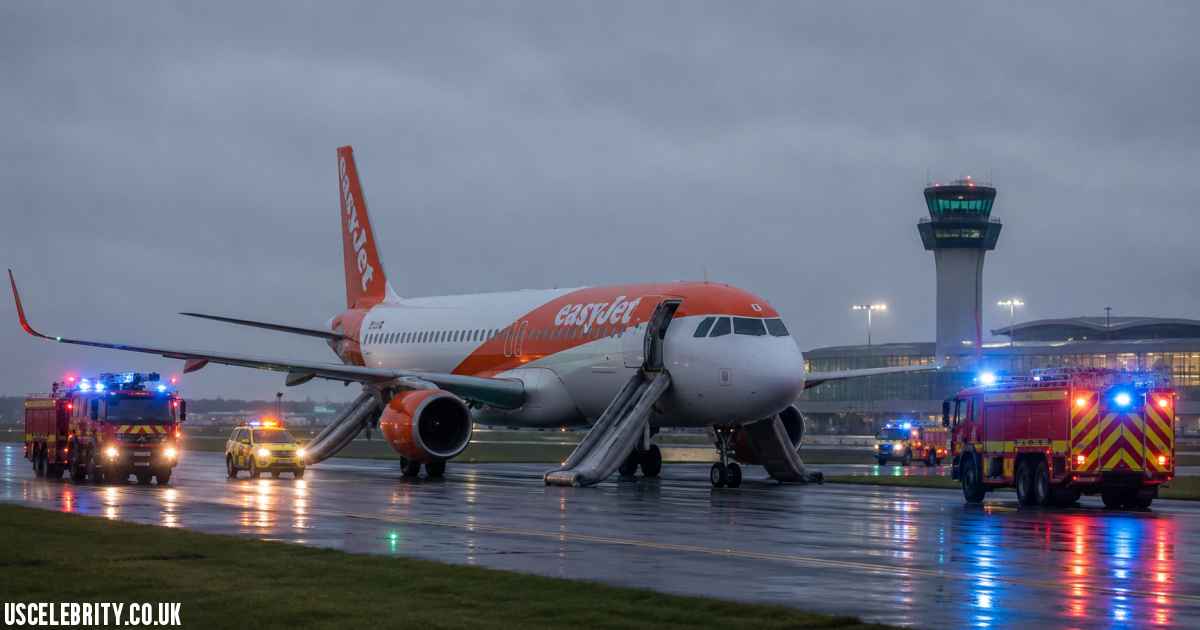
EasyJet Flight U2238 Emergency Landing Newcastle
The incident that has been written about online (easyJet flight U2238 emergency landing Newcastle) was easyJet flight EZY2238 (U22238) departing from Copenhagen, Denmark for Manchester, England.
The aircraft was pushed back at 22:13 local time from Copenhagen, with the time of departure approximately 28 minutes behind schedule, according to flight information published by the public. It was an Airbus A320-214 (registration, G-EZPB) with 178 passengers and six crew.
A passenger complained to the pilot that he was feeling unwell and was taken to a hospital in Ireland just under 15 minutes after he and his family boarded the plane and were flying over the North Sea. The flight crew followed the standard procedures for general aviation and declared a General Emergency, sending the Squawk 7700 emergency code to Air Traffic Control.
Instead of heading towards Manchester, the crew turned to the nearest suitable airport – Newcastle International Airport – where emergency medical teams were already working to prepare for the arrival of the aircraft.
It touched down safely at about 22:52 GMT and North East Ambulance Service paramedics immediately provided medical aid and they were then able to take the passenger to the Royal Victoria Infirmary. The journey to the ground lasted some 70 minutes, and the aircraft took off from Newcastle shortly after midnight and finally landed in Manchester at 00:28 GMT, some 1 hour and 43 minutes late.
Later, EasyJet confirmed that the diversion was the result of a passenger welfare issue, and was outside of their control.
The U2238 and U22238 Flight Numbers were Confused with one another.
This is one of the main issues making it confusing in this story – the same two easyJet flight numbers.
| Flight Code | Route | Role in Incident |
|---|---|---|
| EZY2238 / U22238 | Copenhagen to Manchester | Diverted flight |
| U2238 | Newcastle To Bristol | Regular scheduled service – not involved |
Many websites left out the leading numbers or shortened the number, which quickly mixed up the two services in online searches.
The easyJet U2238 Newcastle-Bristol service is scheduled to run until 2026 with no diversionary service planned and an on-time service rating of 94% is expected.
It is important to note that the aircraft involved in the incident, and not Newcastle–Bristol domestic flight, was EZY2238/U22238.
How the crew responded: Textbook aviation emergency.
Airbus A320-214 G-EZPB was added to easyJet’s fleet on 18 February 2016. At the time of the incident, it was around nine years old, and no public reports of any technical issues were linked to the diversion.
The crew’s emergency procedure was in line with the international aviation safety guidelines.
The passenger was taken to a critical state and the pilots reported a general emergency (Squawk 7700), giving air traffic controllers priority handling.
Newcastle Airport was chosen as the closest appropriate airport to have full emergency medical services.
They were having to hold traffic in the air, with reports that Air France flight AFR1558 had been temporarily diverted into a holding pattern so the runway could be used.
When they landed, the North East Ambulance Service had the necessary emergency personnel on board to attend to the injured passenger and get them to hospital quickly.
After the engineering checks, there were no technical problems with the aircraft (G-EZPB) and the diversion was caused by a medical emergency on board only and not by any mechanical fault.
The effective coordination of the aircraft crew, cabin crew, air traffic control, the airport, engineers and the medical responders highlights the fact that the event is frequently regarded as a textbook case of aviation emergency management.
Under the terms of UK261, can compensation be sought for passengers’ rights?
There were many enquiries after the incident on the availability of compensation.
UK261 (EU261) provides for that airlines will normally have to pay compensation if delays are caused by them.
In this case:
- Delay at destination: 1 hour 43 minutes (approx.)
- Medical emergency while sailing: Cause
- Classification: Extraordinary circumstance
Medical emergencies are regarded as an exception to UK261, meaning that passengers do not normally have a right to financial compensation.
Airlines still have Duty of Care obligations though and may receive:
- Meals and refreshments
- Communication assistance
- Support in the event of long delays
Note that the actual Newcastle-Bristol service (U2238) did not involve this route and therefore claims for compensation arising from this incident would not be accepted.
What are the odds of a medical diversion on a commercial flight?
Medical diversions are a common occurrence in commercial aviation, though they may garner much publicity during an emergency landing.
Industry estimates suggest:
- On approximately one out of every 604 commercial flights, medical emergencies occur.
- Approximately 10% of on-board medical emergencies are requiring diversion to another airport.
- There are over 30 flight diversions each day around the world to perform a variety of tasks, such as medical events, weather and technical problems.
Pilots are trained to put the safety of the passengers ahead of keeping to the flight schedule. The choice of Newcastle enabled the crew to reduce the time necessary for professional medical assistance but still ensure they operated safely throughout the flight.
Cabin crew was reported to be calm throughout and used medical equipment on-board and communicated to passengers about the diversion and kept them in order until landing.
The aircraft then flew on to Manchester where the medical team could help the passenger before the aircraft ground stopped after about 70 minutes.
To prevent any misunderstanding about flight numbers, you can verify EasyJet flight status by following these steps:
Many people are confused by this incident and it is helpful to always double-check the full flight designator to ensure that it is the correct flight.
For reference:
- EZY2238 / U22238 = Copenhagen, medical diversion to Newcastle on 27 October 2025 → Manchester
- U2238 is a scheduled domestic service from Newcastle to Bristol, U2238 (U2238 – Newcastle) is a routine flight and U2238 – Newcastle is a Newcastle to Bristol flight.
Visitors can check flight data from trusted flight tracking sites like Flightradar24, FlightAware, or airline and airport websites.
According to publicly available flight history the Newcastle – Bristol service [U2238] ran during March – June 2026 without any reported issues, with flights finishing about 94% on time.
When checking the full flight number, from airport, to airport and date of flight, it helps to avoid any confusion that might arise from similar flight numbers.
Conclusion
The EasyJet Flight U2238 Emergency Landing Newcastle Story conveys the following key messages:
The widely sought-after “easyJet flight U2238 emergency landing Newcastle” story is about easyJet flight EZY2238 (U22238) from Copenhagen to Manchester on 27th October 2025. After a passenger experienced a critical medical emergency, the aircraft diverted to Newcastle international airport and the crew declared Squawk 7700 and requested immediate priority handling.
It was not a technical failure and engineering examinations revealed the diversion was purely medical in nature and no aircraft damage was caused to the Airbus A320-214 G-EZPB. About 70 minutes later after the ground, the flight took off again, finally landing 1 hour and 43 minutes late at Manchester.
A UK261 financial compensation claim is unlikely to be successful for passengers as it would be a case of a ‘special circumstance’ with financial compensation being limited to covering reasonable care of the passengers, particularly during disruption.
Most importantly, the incident demonstrates the ability of the current aviation safety measures to work. The very quick medical care for the affected passenger was achieved through the co-ordinated response from easyJet’s flight crew, Air Traffic Control, Newcastle Airport and the North East Ambulance Service, ensuring the safety of all passengers on board. Could also be a reminder to check full flight numbers when researching aviation incidents, as U2238 and U22238 are different scheduled flights.